Gemini 4 Argon vs Carbon 2026: What's Different, Which AI Should You Choose?
Published:
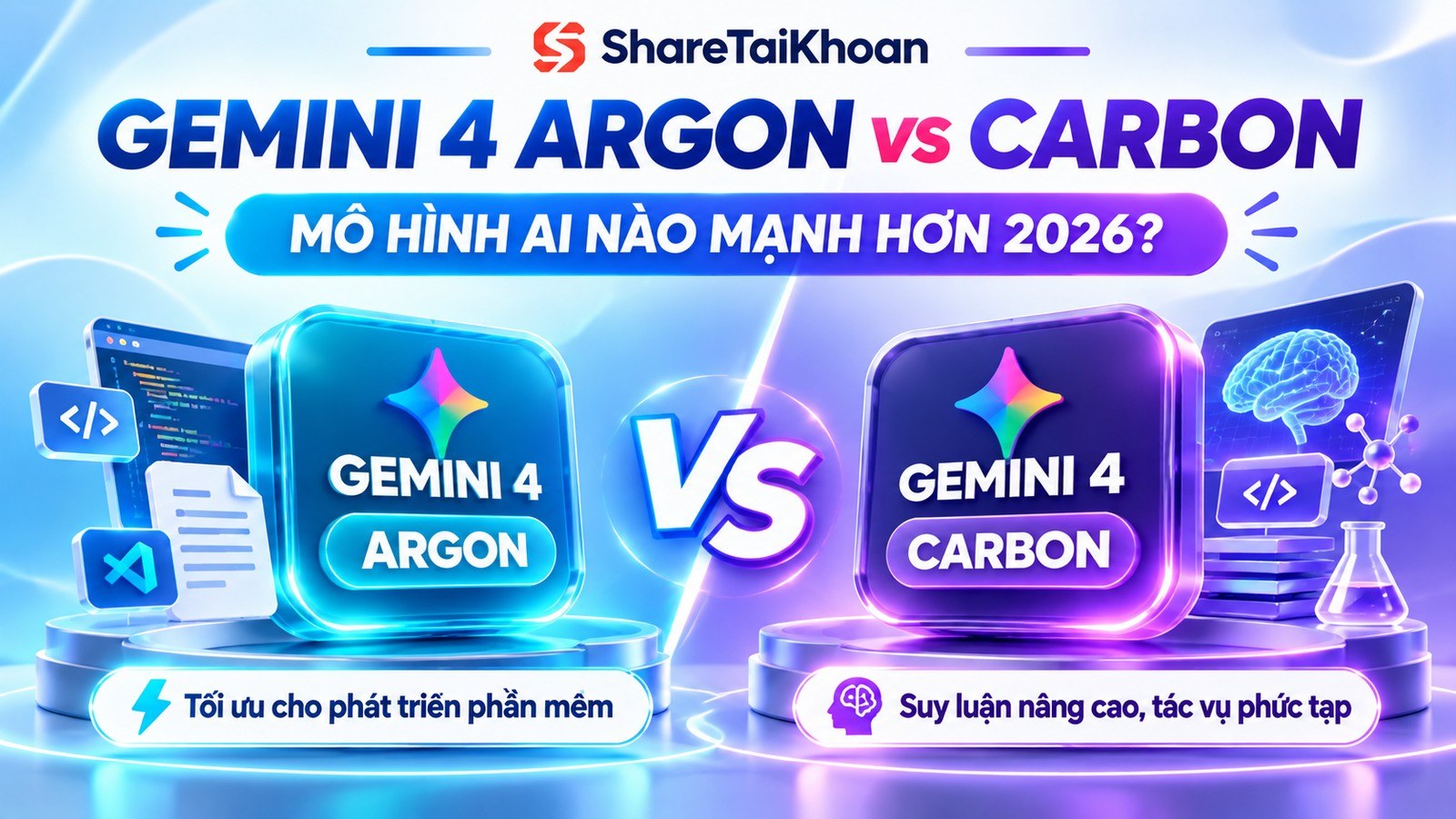
Gemini 4 Carbon has just launched and outperforms Argon on many AI benchmarks. Compare its reasoning, coding, pricing, and access through Google AI Pro and Ultra
Gemini 4 Argon vs. Gemini 4 Carbon: A detailed comparison—Which AI model is more powerful?
Gemini 4 Argon and Gemini 4 Carbon are two advanced artificial intelligence models from Google DeepMind in 2026. If Gemini 4 Argon is designed to handle tasks such as programming, research, document analysis, and automation efficiently, Gemini 4 Carbon further advances in-depth reasoning, solves complex technical problems, and carries out lengthy, multi-step AI workflows.
In particular, on 10/11/2026, Google officially expanded access to Gemini 4 Carbon to developers, businesses, and Google AI Ultra users. This is an important update to the Gemini 4 ecosystem.
So How do Gemini 4 Argon and Gemini 4 Carbon differ? Is Carbon really more powerful than Argon? Which model should you choose for coding, research, and work assistance?
Let's ShareTaiKhoan Learn more in the article below.
What is Gemini 4 Argon?
Gemini 4 Argon is an advanced reasoning AI model in the Gemini 4 generation, announced by Google on 30/09/2026.
This model focuses on complex specialized tasks such as software development, financial analysis, scientific research, and workflow automation.
More than just answering everyday questions, Gemini 4 Argon is designed to handle work that requires planning, tool use, and multistep problem-solving.
The standout capabilities of Gemini 4 Argon include:
Write, analyze, and optimize code.
Supports in-depth research.
Analyzing legal, business, and financial documents.
Solve scientific and engineering problems.
Coordinating multiple tools in an automation workflow.
Handle long contexts of up to around 1 million tokens.
Google positions Argon as a suitable choice for most coding and specialized knowledge work.
What is Gemini 4 Carbon?
Gemini 4 Carbon is a more advanced AI model developed from Gemini 4 Argon.
Google first announced Carbon on 28/10/2026 and officially expanded access from 10/11/2026.
Compared with Argon, Carbon is designed to use more inference resources, explore possible solution paths, and carry out extended verification steps.
The highlights of Gemini 4 Carbon include:
Deep reasoning on complex problems.
Coding and debugging across multiple steps.
Supports software architecture design.
In-depth scientific research.
Run extended AI agent workflows.
Supports challenging analytical and engineering tasks.
Improve the ability to detect uncertain information and reduce unsupported conclusions.
According to Google, Carbon is the most powerful model in the Gemini 4 lineup at the time of its announcement on 10/11/2026.
However, Carbon's stronger performance on many evaluations does not mean that every simple question requires Carbon.
Gemini 4 Argon vs. Gemini 4 Carbon comparison table 2026
Here are the key differences between the two models.
Criteria | Gemini 4 Argon | Gemini 4 Carbon |
|---|---|---|
Developer | Google DeepMind | Google DeepMind |
First announced | 30/09/2026 | 28/10/2026 |
Direction | Professional work, coding, automation | In-depth reasoning, complex, long-running tasks |
Coding ability | Strong | Higher performance across many benchmarks |
Scientific research | Yes | Optimized for difficult problems |
Handle AI agent tasks | Yes | Designed for long and complex workflows |
Context | Up to around 1 million tokens | Up to around 1 million tokens |
Input data | Text and multiple multimodal formats | Text, images, audio, video |
Inference usage | Adjustable thinking level | May use more reasoning tokens |
Yes | Not included in the standard access list | |
Google AI Ultra | Yes | Yes |
Paid API | Yes | Yes |
Best fit | Routine work | Difficult tasks requiring deep reasoning |
According to Google's documentation, both support long context. Carbon is not simply Argon with a larger context window; the main difference lies in its ability to reason and perform complex tasks.
How much more powerful is Gemini 4 Carbon than Argon?
For an objective assessment, you can refer to benchmarks published by Google DeepMind.
Benchmarks are sets of tests used to evaluate an AI model's capabilities on specific tasks.
4.1. Reasoning and knowledge processing
On the Artificial Analysis Intelligence Index version 5.0:
Gemini 4 Argon scored 50 points.
Gemini 4 Carbon scored 59 points.
Carbon scored 9 points higher in this evaluation.
On Vals Index 2.2, Carbon scored 70.4%, compared with 69.2% for Argon.
The results show that Carbon has an advantage in handling complex knowledge tasks, although the degree of improvement depends on the benchmark.
4.2. Coding capabilities
In programming, Google has published several notable results:
Benchmark | Gemini 4 Argon | Gemini 4 Carbon |
|---|---|---|
SWE-sweep | 4,3% | 9,6% |
FrontierSWE 2 | 55,0% | 61,2% |
Terminal-Bench 4.0 | 57,1% | 65,2% |
These results show that Carbon has an advantage in many software engineering tasks, particularly problems that require investigating bugs and carrying out multiple processing steps.
However, benchmark scores do not mean that real-world task execution speed will increase by the same proportion.
4.3. Reliability when performing complex tasks
Google says Carbon improves its ability to identify gaps in the input information.
In Google's published agentic honesty test of 375 tasks:
Gemini 4 Argon scored 70%.
Gemini 4 Carbon scored 92%.
This shows that Carbon performs better on a specific evaluation suite measuring honest behavior when AI performs tasks.
Even so, both models can still produce false or inaccurate information. Users should verify important results before applying them.
Comparing Gemini 4 Argon and Carbon for coding
For developers, this is one of the most important criteria.
Gemini 4 Argon is suitable for routine coding work
Argon can help with:
Write functions and explain source code.
Analyzing the causes of errors.
Optimize a code snippet.
Build application architectures.
Write technical documentation.
Supports code migration or improvement.
Google positions Argon as a suitable choice for most software engineering tasks.
Gemini 4 Carbon is suited to complex problems
Carbon is designed for tasks such as:
Analyzing errors across multiple system components.
Design large-scale software architectures.
Coordinating multiple AI agents to handle a project.
Conduct testing and verification over multiple rounds.
Propose ways to improve complex systems.
For example, if you only need to write a function that processes CSV data, Argon may meet your needs.
But if you need to inspect a large system, find the cause of an error across multiple modules, and propose a verified fix, Carbon is a model worth considering.
Conclusion: For ordinary programming work, start with Argon. For difficult, lengthy problems requiring multiple reasoning steps, Carbon has a clearer advantage in published evaluations.
Comparing research and document analysis capabilities
In addition to programming, Gemini 4 has also been developed to support in-depth knowledge work.
Gemini 4 Argon
Argon is suitable for:
Synthesize information from multiple documents.
Business report analysis.
Explain data and metrics.
Supports work planning.
Research specialized topics.
For example, you can ask:
"Analyze this business report, identify the three main reasons for the revenue decline, and propose ways to improve."
Gemini 4 Carbon
Carbon has an advantage in cases that require extended reasoning, testing multiple hypotheses, and cross-checking conclusions across several steps.
For example:
"Analyze this set of research documents, compare the methodologies used in the studies, identify their limitations, and propose directions for future research."
For tasks like these, Carbon is designed to dedicate additional resources to reasoning and verification.
However, this does not guarantee that every answer from Carbon will be more accurate than Argon's.
Users should check sources and data, especially in high-risk fields such as finance, law, and scientific research.
Comparing the prices of Gemini 4 Argon and Gemini 4 Carbon
Price is an important factor for developers looking to integrate AI models into applications.
7.1. API pricing as of 11/11/2026
According to Google, Argon and Carbon currently have the same introductory pricing for the standard API.
API costs | Argon | Carbon |
|---|---|---|
1 million input tokens | 2 USD | 2 USD |
1 million output tokens | 10 USD | 10 USD |
Introductory price up to | 30/11/2026 | 30/11/2026 |
This is pricing for developers using the API, not a monthly Gemini subscription fee.
Starting December 1, 2026, Google announced that the expected price for these models will rise to 4 USD per million input tokens and 20 USD per million output tokens.
An important point is Carbon can use more reasoning tokens than Argon. to handle the same task.
Therefore, even if the per-million-token rates are equivalent, the total cost of completing a task may still be higher.
7.2. Do Gemini users have to pay API fees?
Not necessarily.
Users who access Gemini through the app have access managed according to their Google AI plan and its corresponding limits.
The API is a different way to use the models, mainly for developers integrating them into software.
Therefore, do not confuse API token pricing with Google AI Pro or Google AI Ultra subscription prices.
Can you use Gemini 4 Argon and Carbon with Google AI Pro?
According to Google's official help page, access to the two different models depends on the subscription plan.
Google AI plan | Argon | Carbon |
|---|---|---|
Free | No | No |
Google AI Plus | No | No |
Google AI Pro | Yes | No |
Google AI Ultra | Yes | Yes |
Google AI Pro supports Argon for eligible users, while Carbon is currently available through Google AI Ultra.
Users should also note that advanced models have their own usage limits.
For business or school accounts, access also depends on the license type and administrative settings.
If you are using an account from a third party, you should check the list of available models directly rather than relying only on the product name.
Which is a better fit for different users, Gemini 4 Argon or Carbon?
Students and learners
For needs such as explaining concepts, supporting learning, summarizing documents, and outlining research, Argon is already a strong choice.
Carbon is better suited to particularly complex research tasks, but not every student needs to upgrade to the highest-tier plan.
Office workers
If your work mainly involves writing reports, analyzing data, developing plans, and processing documents, Argon is worth considering.
Content creators and marketers
Tasks such as writing marketing content, developing SEO plans, analyzing customers, and brainstorming ideas do not necessarily require Carbon.
Users should evaluate the actual quality of the output before deciding to spend more.
Developers and software engineers
Argon is suitable for most everyday tasks.
Carbon is worth considering when you need to solve complex problems, work on large projects, or carry out multi-step processes that require verification.
Researcher
Carbon is designed for problems that demand deep reasoning in science, mathematics, and engineering.
However, AI results should be considered only one part of the research process, not a substitute for independent verification.
Should you upgrade to Gemini 4 Carbon?
The answer depends on how complex the work is.
You may want to consider Gemini 4 Argon if:
Mainly use AI for studying and work.
Frequently write and analyze documents.
Need coding capabilities but do not have to handle overly complex projects.
Want to use a powerful reasoning model in Google AI Pro.
You may want to consider Gemini 4 Carbon if:
Need to solve a difficult technical problem.
Conduct in-depth research.
Regularly use AI agents for long workflows.
Need to test, debug, or analyze multiple system components.
Already have access to Google AI Ultra or a paid API.
The important point is that Carbon is stronger across multiple benchmarks, but that does not mean every user needs to choose the most advanced model.
Explore Gemini accounts at ShareTaiKhoan
If you are exploring Gemini options for study, work, or content creation, you can check out the Gemini Pro service at ShareTaiKhoan.
According to the information displayed on the website, ShareTaiKhoan offers options such as shared accounts and personal account upgrades, with different prices, subscription durations, and terms of use.
However, Gemini Pro on the ShareTaiKhoan product page does not mean that the account has access to Gemini 4 Carbon.
To use Carbon in the Gemini app, Google currently requires access to Google AI Ultra.
Therefore, before purchasing, check the actual model list, usage limits, number of devices allowed, and support policy.
Reference: Gemini Pro at ShareTaiKhoan.
Frequently asked questions about Gemini 4 Argon vs. Carbon
Is Gemini 4 Carbon more powerful than Gemini 4 Argon?
Yes, according to several benchmarks published by Google DeepMind. Carbon scores higher than Argon on tests of reasoning, coding, and complex task handling. However, the degree of improvement is not the same in every situation.
When was Gemini 4 Carbon released?
Google introduced Carbon on 28/10/2026 and expanded access from 10/11/2026.
Is Gemini 4 Argon free?
In the Gemini app, Argon is not on the list of models available to regular free accounts. Google AI Pro supports access to Argon, subject to usage limits.
Can Google AI Pro use Carbon?
According to current information, Google AI Pro supports Argon but does not include Carbon in its standard model list. Carbon is available on Google AI Ultra.
Does Gemini 4 Carbon have higher API costs than Argon?
During the introductory period through November 30, 2026, the two models have the same standard API unit prices. However, Carbon may consume more reasoning tokens, increasing the actual cost per task.
Can Gemini 4 Carbon completely replace Argon?
No. Google continues to position Argon as a suitable choice for most coding and specialized knowledge work, while Carbon focuses on more challenging tasks.
Conclusion: Which is more worth using, Gemini 4 Argon or Gemini 4 Carbon?
Based on the comparison criteria, Gemini 4 Argon and Gemini 4 Carbon can be seen to serve different needs.
Gemini 4 Argon is a practical choice for most professional users, especially when you need to code, analyze documents, conduct research, and automate tasks.
Gemini 4 Carbon is better suited to tasks involving in-depth reasoningsuch as complex software engineering, long-running AI agent tasks, and scientific research.
Although Carbon scores higher on many benchmarks, model selection should still be based on real-world performance, cost, and the needs of the task.
Explore Gemini options at ShareTaiKhoan
You can learn more about the product and the Gemini services currently available at:
View Gemini Pro at ShareTaiKhoan
Confirm model access, plan type, and usage policies before subscribing.
Account Sharing | ShareTaiKhoan
Website: https://sharetaikhoan.com.vn
Zalo/WhatsApp: +84 337 018 337
ShareTaiKhoan is an independent service provider, not the publisher of Gemini or an official Google reseller.
References:
Google – Gemini 4 Argon, announced 30/09/2026.
Google – Gemini 4 Carbon is now available, 10/11/2026.
Google DeepMind – Gemini 4 Carbon Model Card.
Google AI for Developers – Gemini API Pricing.
Google Help – About Gemini models.
Updated on 11/11/2026. Features, API pricing, and access may change over time.
(0 ratings - 0/5)
Buy affordable accounts at ShareTaiKhoan
Related products

Other articles
- What Is New in Suno v6? Models, Studio 2.0 and Plans for 2026
- When Is Black Friday 2026? Sale Schedule & Shopping Tips
- Is Gemma 5 Coming Soon? Google Makes AI 2.85 Times Faster
- Is Meta Muse Free? Plans and Terms of Use
- What is Udemy Business? A corporate training platform
- What is QuillBot? A guide to using QuillBot from A–Z
- What Is TurboScribe? How to Convert Audio, Video to Text
Comments (0)
Sign in or register to comment.
No comments yet.