
Is Gemma 5 Coming Soon? Google Makes AI 2.85 Times Faster

Published:

Gemma 5 E4B is attracting attention in the AI community as predictions emerge about Google's next generation of locally run models. Notably, Google has just announced results showing a 2,85-fold speedup for Gemma 4 E2B thanks to Gemini 4 Argon and vLLM on an NVIDIA A100 GPU. Could this be a stepping stone towards Gemma 5 and a future where AI runs directly on laptops and phones? Join ShareTaiKhoan.com.vn as we analyse official information, unconfirmed expectations and how to start trying local AI today.
Is Gemma 5 launching soon? Google speeds up AI by 2,85 times and the future of local AI
Updated: 20/11/2026
Gemma 5 E4B is attracting attention in the AI community as predictions emerge about Google's next generation of locally run models. Notably, Google has just announced results showing a Gemma 4 E2B speedup of 2,85 times thanks to Gemini 4 Argon and vLLM on an NVIDIA A100 GPU.
Could this be a stepping stone toward Gemma 5 and a future where AI runs directly on laptops and phones? Let's ShareTaiKhoan.com.vn analyze official information, unconfirmed expectations and how to start exploring Local AI today.
Gemma 5 is coming soon: What information has been confirmed?
The AI community is discussing Gemma 5 as the next generation of Google's Gemma family of open-weight models. Some accounts that follow technology news predict that Google is preparing to launch an E4B version designed to run directly on personal devices.
However, as of 20/11/2026, Google has not officially announced the release date, technical specifications or benchmarks for Gemma 5 E4B in the sources checked.
Therefore, it is necessary to distinguish between two categories of information:
Content | Status |
|---|---|
Google has released Gemma 4 | Confirmed |
Gemma 4 has E2B and E4B versions | Confirmed |
Gemini 4 Argon speeds up Gemma 4 E2B by 2,85 times | Confirmed |
Google is preparing to release Gemma 5 E4B | No official announcement yet |
Gemma 5 E4B will be the best local AI model | Predicted, no benchmarks yet |
Distinguishing confirmed information from rumors is especially important when evaluating an unreleased AI model.
Even so, the advances made with Gemma 4 show that Google is investing heavily in operational efficiency and making AI more accessible to users.
What is Gemma? Why are small AI models becoming increasingly important?
Gemma is a family of open-weight AI models developed by Google DeepMind, allowing developers to download the weights and deploy the model on suitable hardware.
Unlike using a chatbot entirely through cloud servers, Gemma can be installed on a personal computer, mobile device or private server.
Google introduced Gemma 4 on 02/04/2026 with E2B, E4B, 26B Mixture of Experts and 31B Dense versions. Google later added a 12B version and other optimised versions.
Among these, E2B and E4B are designed to balance processing capabilities with resource requirements.
Notable Gemma 4 versions
Model | Usage direction |
|---|---|
Gemma 4 E2B | Devices with limited resources |
Gemma 4 E4B | Local AI with more advanced processing capabilities |
Gemma 4 12B | Balance performance and memory usage |
Gemma 4 26B A4B | Mixture of Experts architecture |
Gemma 4 31B | Focus on processing quality and reasoning |
Small versions attract interest because not every AI application needs extremely large models.
For example, an assistant dedicated to summarizing notes, classifying emails or answering questions based on internal documents can work well with a moderately sized model if it is selected and configured appropriately.
This is also why the community expects Gemma 5 E4B to continue improving speed and resource efficiency.
How does Gemini 4 Argon make Gemma 2,85 times faster?
One of the most notable recent technological achievements comes from Gemini 4 Argon.
According to Google's official announcement dated 13/10/2026, Gemini 4 Argon was used to help optimize Gemma 4 E2B inference on a vLLM system with an NVIDIA A100 GPU.
Results published by Google:
Metric | Results |
|---|---|
Test model | Gemma 4 E2B |
Hardware | NVIDIA A100 |
Framework | vLLM |
Throughput before optimization | Around 37.900 tokens/second |
Throughput after optimization | Over 108.000 tokens/second |
Speedup | 2,85 times |
Token similarity | 100% |
Quality degradation | Not observed during testing |
Why does this result matter?
Typically, to make AI processing faster, organizations may need to upgrade hardware, increase computing resources or spend a long time optimizing software.
In this case, Gemini 4 Argon helped shorten the optimization process to just a few days, according to Google's announcement.
This shows that AI is not only used to generate text, images or source code, but can also help improve the efficiency of AI systems themselves.
However, the figure of 108.000 tokens/second needs to be understood correctly.
This is throughput in a benchmark environment on server hardware, not the speed at which a personal laptop can generate responses.
The results were also measured on Gemma 4 E2B, not Gemma 5.
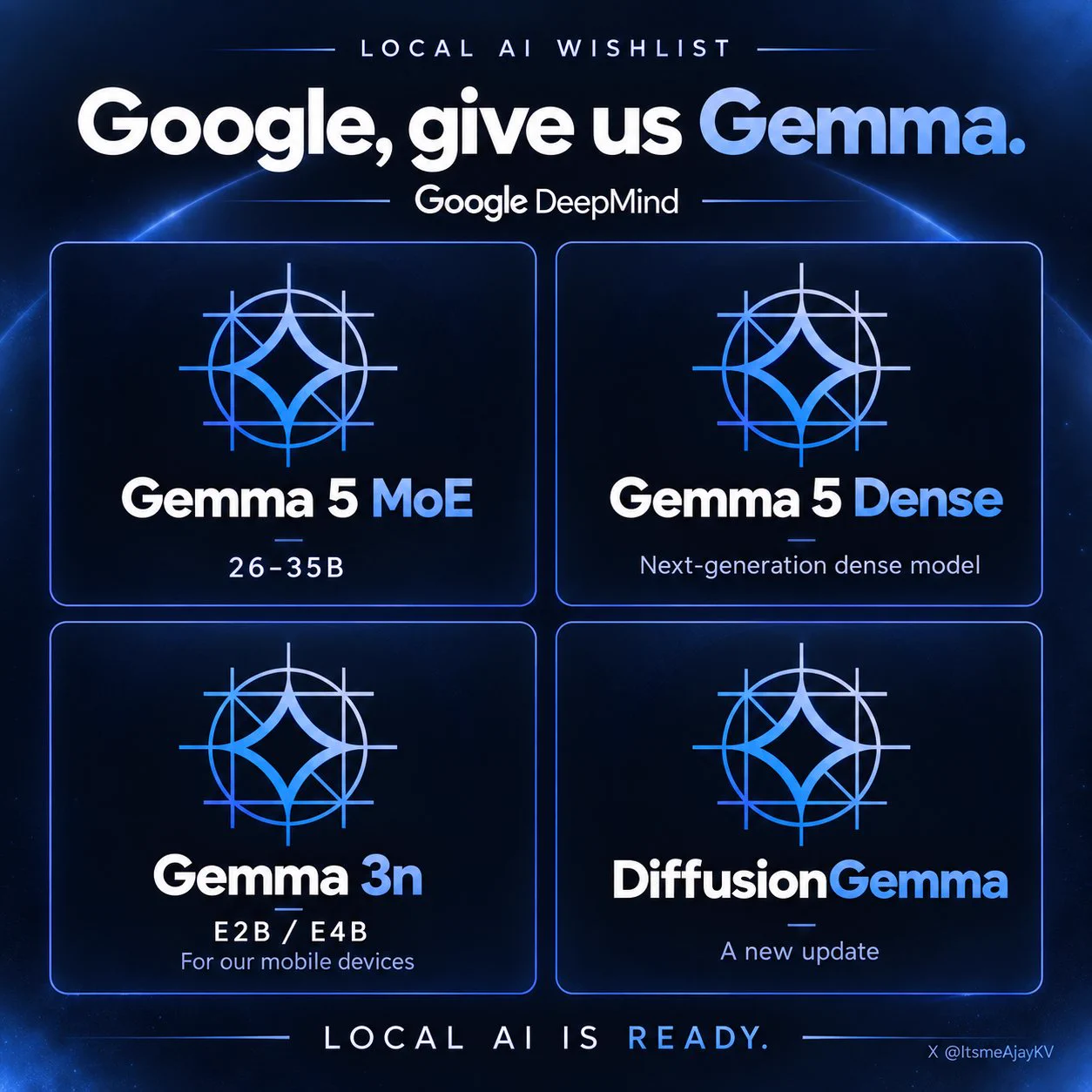
What is Local AI? Why is on-device AI attracting interest?
Local AI is a way of deploying artificial intelligence models on devices or infrastructure controlled by the user, instead of sending all requests to an external cloud service.
For example, you can download a compatible Gemma model to your laptop, open a model management application and chat with AI directly on your computer.
Greater control over data
If the system is configured to run entirely locally, content can be processed without sending requests to an external AI provider.
This is useful when working with personal notes or internal documents.
However, security also depends on the software used, device access permissions and any connected external services.
Can work offline
After downloading the model and the necessary components, many local AI tasks can run without an Internet connection.
This is an advantage when working in places with unstable connectivity.
Cost control
Running AI on your own computer can reduce per-call API costs, but users still need to account for hardware, electricity and maintenance costs.
Customization flexibility
Developers can integrate the model into internal applications, combine it with private data or fine-tune it for a specific task, subject to the license terms and technical capabilities.
These advantages are what make Local AI a trend worth watching for individuals and businesses.
What improvements could Gemma 5 E4B bring?
Although official specifications are not yet available, users can expect the next generation of Gemma to focus on several practical goals.
First, improve reasoning quality. A small model with better reasoning capabilities can be useful for solving problems, analyzing information or assisting with programming.
Second, improve speed. If well optimized, the model can generate responses faster on the same hardware.
Third, reduce memory requirements. Quantization methods and architecture optimization can help make models deployable on a wider range of devices.
Fourth, enhance multimodal processing capabilities. The currently available Gemma generations already support multiple input types. Users can expect future models to improve their ability to understand images or audio.
Fifth, provide better language support. For Vietnamese users, the ability to understand Vietnamese context, express ideas naturally and process specialized documents is important.
Even so, all of the above is expected areas of improvement, not a list of features confirmed by Google for Gemma 5.
For an accurate assessment, it is necessary to wait for the model card, benchmarks and results from real-world use.
A guide to trying Gemma and Local AI on your computer
You do not need to wait for Gemma 5 to be released to try running AI locally.
Two popular tools to get started with are LM Studio and Ollama.
Method 1: Use LM Studio
LM Studio is suitable for those who want to manage and run models through an intuitive interface.
Basic steps:
Access LM Studio.
Download the version compatible with your operating system.
Install and open the application.
Find a released Gemma model compatible with your hardware.
Choose a suitable version and quantization level.
Download the model to your computer.
Open the Chat section to get started.
For example, you can enter:
"Please summarize the following passage into five main points in Vietnamese, retaining the important figures."
Then check the quality of the results and resource usage.
Method 2: Use Ollama
Ollama is suitable for people who want to use AI models via the command line or integrate them into applications.
You can:
Access Ollama.
Install the application.
Find the Gemma model in the library.
Copy the published command for running the compatible version.
Open the terminal and run the command.
Start chatting with the model.
Once the model has been fully downloaded and configured, you can try using it without connecting to a cloud AI service.
Note: Download size, RAM and VRAM requirements depend on model size and quantization level. No single computer configuration is suitable for every Gemma version.
How do Gemma and Gemini differ?
Gemma and Gemini both belong to Google's AI ecosystem but are not exactly the same.
Criteria | Gemma | Gemini |
|---|---|---|
Direction | Open-weight model | Google's family of AI models and services |
Download the weights to your computer | Available with released versions | Not a common way to use Gemini |
Run locally | Available on compatible hardware | Primarily through systems provided by Google |
Customize | Flexibility under the license terms | Dependent on the service and API |
Users | Developers, researchers, individuals | Individuals, businesses, developers |
Example | Gemma 4 E4B | Gemini 4 Argon |
If you need a ready-to-use AI assistant with minimal setup, the Gemini service may be more convenient.
If you want to deploy a model yourself and control the processing environment, Gemma is a more suitable option to explore.
The two ecosystems can also complement each other: advanced Gemini models support research, while Gemma expands AI deployment capabilities on user-managed infrastructure.
Should you wait for Gemma 5 or use Gemma 4 now?
If your goal is to learn how to run local AI, without having to wait for Gemma 5.
Gemma 4 already has multiple versions with deployment options suited to different configurations.
Beginners can start with a small model to learn how to install it, check memory and evaluate response quality.
If you need to deploy a product in practice, choose a model based on test data and application requirements rather than simply waiting for the next generation.
On the other hand, if you are researching AI technology or preparing to upgrade your system, Gemma 5 is a topic worth following.
When Google makes an official announcement, at least four factors should be compared:
Reasoning quality on real-world tasks.
Performance on your existing hardware.
Memory capacity and response speed.
Licences, tools and integration capabilities.
A model is only truly good when it meets deployment needs, not simply because it is a newer version.
Frequently asked questions about Gemma 5
Has Gemma 5 been released yet?
As of 20/11/2026, there has been no official release announcement from Google about Gemma 5 in the sources checked.
Can Gemma 5 E4B run on a laptop?
This cannot be confirmed until Google announces the specifications. However, Gemma 4 E4B was developed with a focus on deployment on devices with more limited resources than those required by large models.
Is Gemma free?
Gemma is a family of open-weight models. Released versions can be downloaded and used under their respective licences, but hardware deployment or service costs may still apply.
How many times faster is Gemma 5 than Gemma 4?
There are currently no official benchmarks to draw a conclusion. The 2,85-fold figure comes from optimizing Gemma 4 E2B using Gemini 4 Argon in a specific test environment.
Does Local AI need the Internet?
Some Local AI applications can work offline once the model and required components have been fully downloaded. However, features that integrate external services may still require the Internet.
Does Gemma 4 support Vietnamese?
Gemma 4 is designed to support multiple languages, but its accuracy in Vietnamese depends on the model, task and configuration. Testing on real-world data is recommended before using it for important work.
Conclusion: Gemma 5 is worth waiting for, but current progress is already very impressive
Gemma 5 E4B is raising expectations for a more powerful, faster and more accessible generation of local AI. However, claims about performance and the release date still need to be confirmed when Google makes an official announcement.
Meanwhile, the 2,85-fold speedup of Gemma 4 E2B achieved with Gemini 4 Argon shows a clear trend: AI is advancing not only by increasing model size but also by improving deployment efficiency.
For individual users, this is an opportunity to explore AI assistants that can run directly on their own devices.
For developers and businesses, Local AI offers more options in terms of cost, control and integration capabilities.
If you want to get started right away, you can try Gemma 4 through LM Studio or Ollama and wait for further official information from Google.
Together ShareTaiKhoan.com.vn follow updates on Gemma 5, Gemini and the latest AI trends.
References
Updated on 20/11/2026. The content about Gemma 5 consists of technology predictions at the time of writing, not an official launch announcement.
#Gemma5 #Gemma4 #Gemini4Argon #LocalAI #GoogleAI #AIModels #vLLM #ShareTaiKhoan
(0 ratings - 0/5)
Buy affordable accounts at ShareTaiKhoan
Compare packages
| Product | Package | Type | Price | |
|---|---|---|---|---|
| Gemini Pro | Pro - 1 month | Shared | 149.000₫ | Buy |
| Gemini Pro | Pro - 3 months | Shared | 399.000₫ | Buy |
| Gemini Pro | Pro - 1 year | Shared | 1.299.000₫ | Buy |
| Gemini Pro | Pro - Lifetime | Shared | 2.899.000₫ | Buy |
| Gemini Ultra | Ultra - 1 month | Shared | 299.000₫ | Buy |
| Gemini Ultra | Ultra - 1 year | Shared | 2.900.000₫ | Buy |
| Gemini Ultra | Ultra - 1 month | Own account | 699.000₫ | Buy |
| Gemini Ultra | Ultra - 1 year | Own account | 6.900.000₫ | Buy |
Related products

Other articles
- What Is New in Suno v6? Models, Studio 2.0 and Plans for 2026
- When Is Black Friday 2026? Sale Schedule & Shopping Tips
- Is Meta Muse Free? Plans and Terms of Use
- What is Udemy Business? A corporate training platform
- What is QuillBot? A guide to using QuillBot from A–Z
- What Is TurboScribe? How to Convert Audio, Video to Text
- What Is Otter AI? A Guide to Recording Audio, Converting Speech to Text
Comments (0)
Sign in or register to comment.
No comments yet.