Elicit AI vs Consensus AI 2026: Which research tool should you choose?
Published:
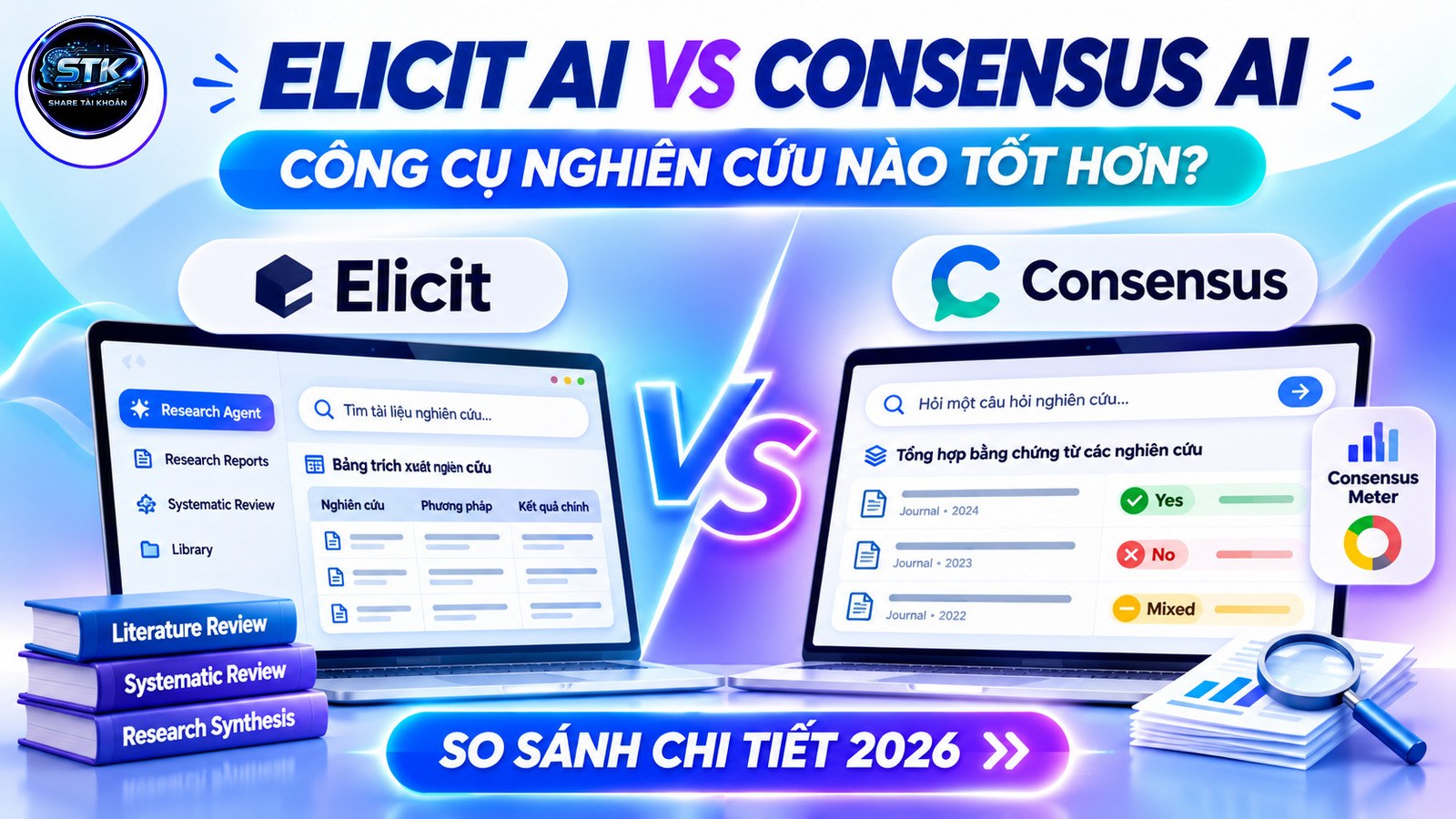
Elicit AI vs. Consensus AI in 2026: A detailed comparison—which research tool is better?
Are you working on a graduation thesis, master’s thesis, or scientific research project and looking to find sources faster but unsure whether to choose Elicit AI or Consensus AI? Both are artificial intelligence tools designed to support academic research, allowing you to search for scientific papers, understand research findings, and synthesize evidence from multiple sources.
However, Elicit AI and Consensus AI have different strengths. Elicit focuses on structured research workflows, data extraction, comparison tables, and support for Systematic Literature Reviews. Consensus, on the other hand, stands out for finding answers based on scientific research, displaying the level of agreement among studies, and generating overview reports through Deep Review.
So How do Elicit AI and Consensus AI differ in 2026? Which tool is better for conducting a Literature Review, finding research gaps, analyzing papers, and supporting thesis writing? Which platform's Free or Pro plan is worth using?
Let's ShareTaiKhoan a detailed comparison to help you choose the tool best suited to your research needs.
What are Elicit AI and Consensus AI?
1.1. What Is Elicit AI?
Elicit AI is an artificial intelligence platform for scientific research that helps users find, analyze, and synthesize data from academic works.
According to official information, Elicit allows searches across a database of more than 138 million scientific papers, combined with specialized research sources and user-provided documents.
Key features include:
Search for scientific papers based on a research question.
Read and summarize academic papers.
Extract data from multiple studies.
Build a comparison table of studies.
Synthesize evidence and create Research Reports.
Supports the Systematic Literature Review workflow.
Import documents and reference data from Zotero.
Check the evidence supporting the claims.
Elicit is a good fit for people who need to process literature using a rigorous research workflow, especially when comparing many studies with different methods and results.
Official website: https://elicit.com
1.2. What is Consensus AI?
Consensus AI is an academic search tool that uses artificial intelligence to find, analyze, and synthesize information from scientific research.
Consensus is designed to help users ask questions in natural language and receive answers based on the studies it finds.
According to official documentation, Consensus currently searches a database of more than 400 million research papers.
Notable features include:
Search for papers by question or keyword.
Generate answers with research citations.
Summarize scientific findings.
Display the Consensus Meter.
View each study's Study Snapshot.
Conduct Deep Review.
Compare supporting and conflicting evidence.
Export the reference list.
Organize research materials in a library.
Consensus is suited to people who want to quickly check how a topic has been studied and whether the available evidence supports or challenges a claim.
Official website: https://consensus.app
Elicit AI vs Consensus AI comparison table for 2026
Below is a table summarizing the key differences between the two platforms.
Criteria | Elicit AI | Consensus AI |
|---|---|---|
Primary purpose | Research and evidence synthesis process | Find and explain research findings |
Publication database. | More than 138 million papers | More than 400 million papers |
Semantic search | Yes | Yes |
Summarize research | Yes | Yes |
Data extraction | Strong, customizable table | Yes, through the analysis tool and Snapshot. |
Literature Review | Research Agent and Reports | Pro Search and Deep Review |
Systematic Review | Includes a specialized workflow. | Supports reviews, but is not equivalent to the Elicit workflow |
Consensus Meter | No equivalent feature | Yes |
Study Snapshot | Data extraction by criteria | Includes a quick summary table. |
Zotero integration | Yes | Includes a reference data export method. |
Analyze uploaded documents | Yes | Available in eligible features. |
Free version | Yes | Yes |
Suitable for | A tool for building research summary tables | A tool for searching for and evaluating scientific evidence |
Note: The number of papers in a database does not equate to the number of papers with full-text access, nor does it mean that search quality is always better. The two platforms have different data sources, indexing methods, and ranking algorithms.
Comparing Their Ability to Search for Scientific Papers
Searching for literature is an important step in conducting research.
3.1. How does Elicit AI search for research papers?
Elicit uses semantic search to identify papers relevant to a research question.
For example, if you enter:
"What factors influence the professional readiness of pre-service English teachers?"
Elicit can find studies related to career readiness, teaching internships, teaching competencies, and teacher education programs.
After obtaining the results, users can continue asking the system to extract the data needed to create a summary table.
This is convenient if you already have clear research questions and need to prepare a literature matrix.
3.2. How does Consensus AI search for research papers?
Consensus lets you search using natural-language questions, keywords, paper titles, author names, and other relevant academic information.
For example:
"Does teaching practicum improve pre-service teachers' classroom management skills?"
Consensus will find relevant studies and help synthesize their key findings.
Users can view papers, use filters, and ask follow-up questions to explore a topic in greater depth.
3.3. Which Tool Is Better at Searching?
You cannot conclude that one platform always finds higher-quality literature based solely on the size of its database.
If you want to find research and extract it into a table for your thesis, Elicit is worth considering.
If you want to ask a specific scientific question and quickly review the evidence, Consensus offers a more suitable workflow.
For important academic projects, you should also consult Google Scholar, subject-specific databases, and systematic literature search methods.
Elicit AI vs Consensus: Which tool is better for writing a literature review?
A literature review is an important part of a thesis, dissertation, and scientific article.
The goal is not only to list previous studies, but also to compare methods, analyze results, and identify research gaps.
Elicit AI supports Literature Reviews.
Elicit lets you build a research summary table based on specific criteria.
For example:
Criteria | Content to extract |
|---|---|
Author & Year | Author and publication year |
Research Context | Research context |
Participants | Study population and sample size |
Methodology | Research method |
Key Findings | Key results |
Limitations | Limitations |
Research Gap | Issue requiring further research |
From this dataset, you can continue grouping studies by topic and develop arguments for the literature review section.
Elicit is a good fit for people who need a clear, easy-to-check extraction table that can be used throughout the research process.
Consensus AI supports literature reviews
Consensus has a Deep Review feature for analyzing a topic in multiple steps.
According to the developer, Deep Review can analyze dozens of relevant papers, synthesize key findings, and present a cited report.
For example:
"Review the evidence on the relationship between teaching practicum and professional readiness among pre-service teachers."
Consensus can help identify trends in findings, areas of disagreement, and issues that require further investigation.
Conclusion
Elicit is a better fit when you need to extract and compare data in a structured research table.
Consensus is a better fit when you want a quick overview of the scientific evidence relevant to a question.
Both support Literature Reviews, but AI-generated results are no substitute for reading, critically appraising, and citing the original works.
Comparing Elicit Research Agent and Consensus Deep Review
These are two notable feature sets of Elicit and Consensus in 2026.
Elicit Research Agent
Research Agent was developed by Elicit to handle multi-step research requests.
Users can ask AI to find papers, extract data, analyze information, and create reports with citations.
Research Agent also supports combining supplementary data sources within the scope of access, including user-uploaded documents and specialized data.
Consensus Deep Review
Consensus Deep Review focuses on synthesizing research papers in response to a specific question.
The tool can break a problem into smaller questions, run multiple searches, and synthesize the findings into a structured report.
Consensus describes Deep Review as a tool for supporting in-depth literature reviews, with the scope of analysis varying according to the question and the documents found.
Key differences
Elicit Research Agent is suited to workflows that require creating multiple research outputs, such as extraction tables, reports, or structured data.
Consensus Deep Review is suited to quickly exploring a topic and synthesizing relevant evidence from academic literature.
What is Consensus Meter? Does Elicit have a similar feature?
Consensus Meter is a distinctive feature of Consensus.
When users ask a question that can be evaluated in terms of agreement or disagreement, Consensus can analyze relevant studies and display the trend in their findings.
The result categories include:
Yes: Research supports the claim.
No: The study does not support the claim.
Possibly: There is partial or conditional support.
Mixed: The results contain conflicting findings.
For example, the question:
"Does regular physical activity improve sleep quality?"
Consensus can display the distribution of findings across relevant studies.
According to the developer's documentation, Consensus Meter is based on up to 20 relevant research results and requires at least 5 related papers to generate a result.
Therefore, Consensus Meter is not the conclusion of the entire scientific community.
It only reflects the group of studies analyzed by the system for a specific query and may miss important differences in population, methodology, or context.
Elicit does not have an equivalent Consensus Meter display tool, but users can ask the Research Agent to classify findings as supporting, opposing, or inconclusive.
Comparing research data extraction capabilities
Elicit AI
Elicit stands out for its ability to extract data from multiple papers using information fields defined by the user.
For example, you can ask:
"Extract the research method, participants, sample size, findings, and limitations from each selected paper."
After that, Elicit helps present the data in a table and allows users to check the relevant evidence.
This feature is useful when you need to build a literature review matrix for your thesis.
Consensus AI
Consensus has a Study Snapshot feature that helps users quickly view key information about a research paper, such as:
Research subject.
Sample size.
Research duration.
Context or country.
Method.
Variables and outcomes.
Key findings.
Consensus can also help compare studies in its AI analysis.
Which tool should you choose?
If you want to build a customizable data table for many papers, Elicit has a clear advantage.
If you want a quick overview of each study's characteristics before deciding whether to read the full text, Consensus Study Snapshot is very convenient.
Elicit AI and Consensus AI pricing comparison for 2026
Cost is a factor to consider when students or researchers want to use advanced AI features.
8.1. Elicit AI pricing
According to the official pricing table:
Plan | Reference price |
|---|---|
Basic | Free |
Plus | 11 USD/month when billed annually |
Pro | 39 USD/month when billed annually |
Scale | 89 USD/month when billed annually |
Enterprise | Contact us for a quote |
The prices of 11 USD, 39 USD, and 89 USD are monthly equivalents when billed annually.
The Plus plan is suitable for people who need to use the Research Agent more often, export data, and build research tables.
The Pro plan expands usage limits and provides a dedicated Systematic Literature Review workflow, with screening for up to 5.000 papers according to the published plan details.
8.2. Consensus AI pricing
According to official information:
Plan | Reference price |
|---|---|
Free | Free |
Monthly Pro plan | $20/month |
Pro (annual billing) | 144 USD/year |
Deep, monthly plan. | 65 USD/month |
Deep, annual plan. | 540 USD/year |
Teams | Team pricing |
With annual billing, Consensus Pro costs the equivalent of 12 USD/month and Deep costs the equivalent of 45 USD/month.
Higher-tier plans expand search and analysis capabilities and provide more Deep Review sessions.
8.3. Cost comparison
Criteria | Elicit Plus | Consensus Pro |
|---|---|---|
Annualized price with annual billing | 11 USD/month | 12 USD/month |
Total annual cost | 132 USD | 144 USD |
Strengths | Data extraction and synthesis | Search and analyze evidence |
Suitable | Structured research | Literature search and review |
The price difference between these two plans is fairly small.
However, users should not rely solely on the subscription fee; they should evaluate the limits and features that genuinely serve their research topic.
Prices as of 13/11/2026; they may change according to the publishers’ policies.
Elicit Free vs Consensus Free: Which free version is better?
Elicit Basic
The Elicit free plan supports:
Search academic literature databases.
Summarize research.
Chat with accessible documents.
View the evidence sources.
Use Research Agent and Research Reports within the free limits.
This is a suitable option for getting started on compiling a reading list for a research topic.
Consensus Free
The Consensus free plan supports:
Search for papers with unlimited basic searches.
10 Pro messages per month, according to the published benefits.
3 Deep Reviews per month.
10 Study Snapshots per month.
Some API access is limited.
This is a worthwhile option if you want to try question-based search and synthesize research findings.
Which free version should you try?
You can start with both.
Use the same research question to compare the literature found, how easy citations are to verify, and the quality of the synthesis.
Hands-on testing will help you make a better choice than simply looking at a feature comparison table.
Should you choose Elicit or Consensus for your thesis?
Undergraduate students
If you are just starting to search for literature, Consensus can help you quickly explore a topic and read related research findings.
Elicit is a good fit when you need to build a summary table of studies for the related research section.
Graduate student
If you are building a literature review involving many papers and specific analysis criteria, Elicit is worth considering.
Consensus is also useful for checking academic claims and finding studies with differing results.
Doctoral researchers
For a Systematic Literature Review or a structured data synthesis process, Elicit Pro offers specialized features.
Consensus Deep Review can serve as a supplementary tool for finding and synthesizing evidence.
However, these tools do not automatically replace a systematic review process designed to meet academic standards.
Lecturers and researchers
You can combine both to explore a topic, find evidence, check results, and create an extraction table.
The final decision should be based on the research methodology, document coverage, and degree of source verification.
Practical example: Using Elicit and Consensus for the same research topic
Suppose you are researching:
"Professional Readiness of Pre-Service English Teachers."
Step 1: Use Consensus
Enter a question:
"What does existing research say about the professional readiness of pre-service English teachers?"
Consensus can help find relevant studies and synthesize trends in their findings.
Try further:
"Does teaching practicum improve pre-service teachers' professional readiness?"
For a question of this type, you can check whether the Consensus Meter appears, depending on the number and characteristics of relevant research results.
Step 2: Use Elicit
Import:
"Find empirical studies on professional readiness among pre-service English teachers."
After finding the literature, ask:
"Extract research context, participants, methodology, readiness dimensions, key findings, and limitations into a comparison table."
Step 3: Compare the results
Check how the studies found by the two platforms are similar and different.
You should also verify the authors’ names, publication year, DOI, and the article’s content.
Step 4: Identify research gaps
Based on verified studies, compare aspects that have been explored with issues for which there is not yet sufficient evidence.
Step 5: Write the literature review
Use the summary table to build topic-based arguments rather than copying verbatim passages generated by AI.
This combination lets you take advantage of both tools’ strengths in the same research workflow.
Pros and cons of Elicit AI
Advantages
Supports structured research workflows.
Extract data according to specific criteria.
Create a summary table of studies.
Includes a workflow for Systematic Literature Reviews.
Combine multiple research data sources.
Supports evidence checking.
Limitations
Advanced features require a suitable plan.
Does not guarantee that all relevant studies will be found.
Some papers do not offer full-text access.
AI can still extract or interpret information incorrectly.
New users may need time to get used to building a research table.
Pros and cons of Consensus AI
Advantages
Search easily using natural-language questions.
Large research database.
Includes a Consensus Meter for exploring consensus trends.
Study Snapshot helps readers quickly review key information.
Deep Review supports in-depth research synthesis.
Includes cited sources for cross-checking.
Limitations
Consensus Meter does not reflect all the research in a field.
AI may incorrectly classify research findings.
The quality of summaries depends on the available documents.
Advanced Deep Review sessions are limited by plan.
Researchers still need to read the full text and assess the quality of the methodology.
Important considerations when using AI for scientific research
Do not cite AI instead of the original paper
When using findings from Elicit or Consensus, check and cite the original research papers.
Check the sources
Verify the author's name, publication year, journal, DOI, and actual content.
Do not use the number of studies as the only measure
A small group of methodologically rigorous studies may provide more relevant evidence than many studies with major limitations.
Use caution with Systematic Reviews.
For a systematic literature review, you need to define the search strategy, selection criteria, screening process, and risk-of-bias assessment.
Protecting research data
Do not upload personal data, confidential interview transcripts, or documents you are not authorized to share to an external platform.
Comply with academic guidelines
The use of AI in a thesis or article must comply with the requirements of the educational institution and publisher.
Frequently asked questions about Elicit AI vs Consensus AI
Which tool is better, Elicit AI or Consensus?
No tool is best for every need. Elicit is suitable for structured extraction and synthesis of research data, while Consensus is suitable for searching and evaluating scientific evidence.
Are Elicit and Consensus free?
Yes. Both offer free plans with different features and limits.
Should you use Elicit or Consensus to write a literature review?
If you need a detailed research extraction table, Elicit is worth considering. If you need a quick synthesis of findings and conflicting opinions, Consensus has an advantage with Deep Review.
Is Consensus Meter reliable?
This is a tool for exploring evidence trends, not a final conclusion representing the entire scientific community. Users need to review the studies analyzed.
Does Elicit support Systematic Literature Reviews?
Yes. Elicit offers a specialized Systematic Literature Review workflow in eligible plans.
Can Consensus find scientific papers?
Yes. According to the developer, Consensus supports searches across a database of more than 400 million research papers.
Which plan should you buy, Elicit Pro or Consensus Pro?
Elicit Pro is suited to in-depth research workflows involving extraction, screening, and synthesis. Consensus Pro is suited to users who regularly use advanced search and Deep Review.
Should you buy both Elicit and Consensus?
Only consider it if you conduct research regularly and genuinely need two different workflows. For basic needs, try the free version first.
Conclusion: Is Elicit AI or Consensus AI more worthwhile in 2026?
Based on the comparison criteria, it is clear that Elicit AI and Consensus AI are both valuable tools for scientific research.", but serves different needs.
Choose Elicit AI if you regularly build Literature Reviews, need to extract information from multiple papers, create summary tables, and process studies using a structured workflow.
Choose Consensus AI if you want to quickly find answers based on academic evidence, explore studies that support or oppose a claim, and use Deep Review to synthesize information.
If your budget is limited, start with the free plan and evaluate how well it works for your own research topic.
Explore AI tools for research at ShareTaiKhoan
Are you looking for AI tools to support learning, document processing, or scientific research?
Access ShareTaiKhoan to explore more how-to guides, feature comparisons, and AI service options suited to your needs.
Website: https://sharetaikhoan.com.vn
Zalo/WhatsApp: +84 337 018 337
Account Sharing | ShareTaiKhoan
ShareTaiKhoan is an independent service provider, not the developer of Elicit or Consensus, nor an officially confirmed agent of either publisher.
Official reference sources:
Elicit Pricing: https://elicit.com/pricing
Elicit Research Agent: https://elicit.com/solutions/research-agent
Consensus Pricing: https://consensus.app/pricing/
Consensus Help Center: https://help.consensus.app
Consensus Meter: https://help.consensus.app/en/articles/10069920-the-consensus-meter
Updated 13/11/2026. Prices, limits, and features may change according to each platform's policies.
(0 ratings - 0/5)
Buy affordable accounts at ShareTaiKhoan

Related products


Other articles
- Elicit AI vs Google Scholar 2026: Which Tool Should You Choose?
- What Is Elicit AI? A Guide to Finding Research Literature
- Systematic Literature Reviews with Elicit: A 6-Step Process
- Elicit Pro: Features, intended users and tips for choosing an account
- Kahoot or Wayground (Quizizz)? Choose Based on Your Lesson Style
- Is Google Antigravity or Cursor Better? Comparing Two AI IDEs
- Is Claude or ChatGPT Better? A Task-by-Task Comparison
Comments (0)
Sign in or register to comment.
No comments yet.