
Using Perplexity for Keyword Research and SEO Competitor Analysis

Published:

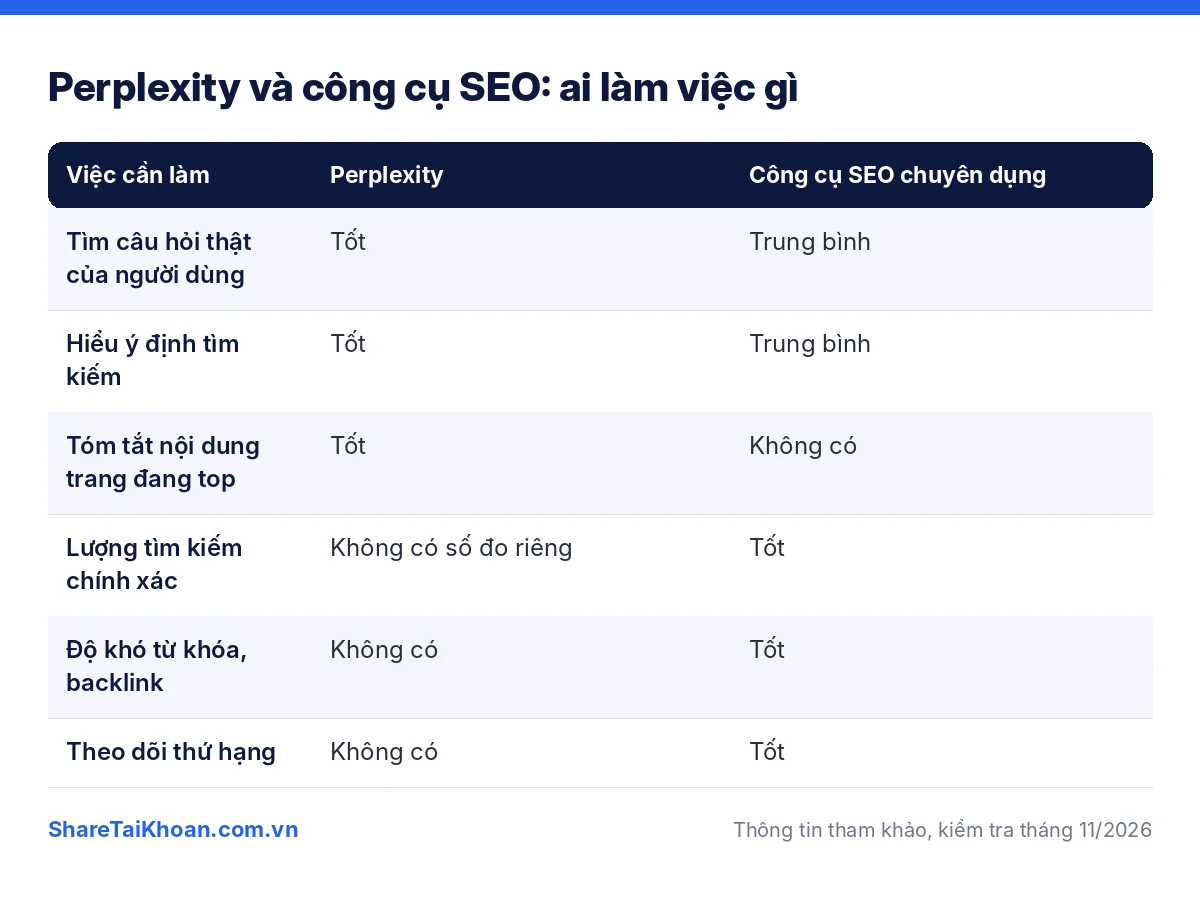
Perplexity is not an SEO tool: it has no database of search volumes or backlinks. But it is very fast at something SEO tools do poorly, namely reading comprehension: what users are really asking, how top-ranking pages answer them, and what is still missing. Used in the right role, it shortens the research stage for an article from half a day to under an hour.
Using Perplexity for keyword research and SEO competitor analysis: a 4-step workflow for content creators
Perplexity is not an SEO tool: it has no database of search volumes or backlinks. But it is very fast at something SEO tools do poorly, namely reading comprehension: what users are really asking, how top-ranking pages answer them, and what is still missing. Used in the right role, it shortens the research stage for an article from half a day to under an hour.
Step 1. Find real user questions
Start with a topic, not a keyword.
I write a blog for a store that sells air purifiers in Vietnam. Search forums, community groups, Q&A sections, and comments: What do first-time buyers usually ask before making a purchase? Group the questions by stage: research, comparison, purchase decision, and after purchase. Cite sources for each group.
Next, explore one group in more depth:
Within the comparison group, which criteria do users debate most? What words do they use to describe the issues?
Users' own words are the raw material for titles and H2 headings. This is something a keyword table does not give you.
Step 2. Analyse pages that are currently ranking
Find pages currently ranking prominently for the query "air purifier for a 20m2 room". For each page, create a table showing: page type (article, category, video), angle, main sections, strengths, and anything missing or outdated.
Then ask the most important question:
Based on the table above, which questions remain unanswered for readers? What should a new article include to be far more useful than these pages?
Note: the results Perplexity finds do not exactly match the Google results page in Vietnam. Search for the query yourself on Google in incognito mode and add any pages Perplexity missed.
Step 3. Build an outline based on content gaps
Create an article outline for the query above, aimed at first-time buyers. Requirements: answer the main question within the first 100 words; each H2 should answer a real question from step 1; include a comparison table; include a section on common mistakes; suggest 5 questions for the FAQ section. Mark any sections that require data or first-hand experience that I need to add myself.
The final sentence helps you identify which parts cannot be delegated to AI. An article that merely summarises what is already online will not outperform the top-ranking pages; what sets it apart comes from photos you take yourself, measurements from your own tests and your sales experience.
Step 4. Verify with data
Only at this point do you open an SEO tool:
Enter the phrases from step 1 into a keyword tool to check search volume and difficulty.
Choose one primary keyword and 3–5 secondary keywords with the same search intent.
Check whether your site already has an article targeting the same keyword, to avoid having two articles compete with each other.
If you do not yet have a tool, ShareTaiKhoan has Semrush and KeywordTool.
8 prompts to reuse every week
"News and policy changes from the past 30 days related to [industry] in Vietnam, with sources."
"New terms users have started searching for in the topic of [X] this year."
"Compare how [competitor A] and [competitor B] present their [product type] pages: structure, calls to action, and supporting content."
"What information in the article at [URL] is outdated compared with current official sources?"
"List reliable statistics about [topic], with the source and year for each figure."
"Suggest 10 supporting article topics for the [product] page, and specify the search intent for each topic."
"What do users complain about most regarding [product type]? Summarise findings from public reviews."
"Check the following passage for unsupported claims: [paste passage]."
3 things not to do
Do not get search volume figures from Perplexity. Any figures it provides are quoted from other pages and are often outdated.
Do not copy the summary and turn it into an article. Use it for research, then write in your own voice using your own data.
Do not skip opening the sources. An incorrect citation in an article will reduce the credibility of the entire page.
Frequently asked questions
Can Perplexity replace Semrush or Ahrefs?
No. The two types of tools complement each other: Perplexity helps you understand users and content, while SEO tools provide metrics.
Is the free plan enough for SEO?
Enough to try out the workflow. If you do this every week, the Pro plan is more convenient thanks to higher limits and Deep Research. See Perplexity product page and the article how to write a brief for Deep Research.
Should you optimise your content to be cited by Perplexity?
Yes. Pages that answer questions directly, provide original data and clearly show their update dates are often prioritised for citation by AI search engines.
References
ShareTaiKhoan is an independent service, not Perplexity AI or a representative of Perplexity AI. Prices, usage limits and terms are determined by the provider and may change; the information in this article was checked in 11/2026.
(0 ratings - 0/5)
Buy affordable accounts at ShareTaiKhoan
Related products


Other articles
- Canva Pro or Photoshop? A Comparison for Marketing in 2026
- Runway Act-Two: Animate AI Characters Using Your Video
- Systematic Literature Reviews with Elicit: A 6-Step Process
- Semrush One and AI Visibility: Measuring Brand Presence in ChatGPT
- Create Natural-Sounding Vietnamese AI Voiceovers with Vbee: 7 Techniques
- How to Find Bestselling TikTok Shop Products with Kalodata
- Adding Voiceovers to Videos and Lectures with Vbee: A 6-Step Process
Comments (0)
Sign in or register to comment.
No comments yet.