
How to Find Bestselling TikTok Shop Products with Kalodata

Published:

On TikTok Shop, those who struggle usually do not lack products to sell. They discover products too late: by the time an item is all over the For You feed, prices have been driven down and major creators have captured all the attention. Kalodata helps you spot opportunities earlier through data. But the tool only provides tables of numbers; sound decisions come from how you filter them.
Find promising TikTok Shop products with Kalodata: a 4-step filtering process and scoring table
On TikTok Shop, those who struggle usually do not lack products to sell. They discover products too late: by the time an item is all over the For You feed, prices have been driven down and major creators have captured all the attention. Kalodata helps you spot opportunities earlier through data. But the tool only provides tables of numbers; sound decisions come from how you filter them.
Before you start: understand the data correctly
Kalodata collects public signals on TikTok and then estimate revenue and sales volume. These are not the platform's official transaction figures.
So use the data to make relative comparisons and identify trends, not as an accounting report.
Kalodata does not have a permanent free plan; it offers a trial period, followed by paid plans that differ in daily search limits and the length of historical data available.
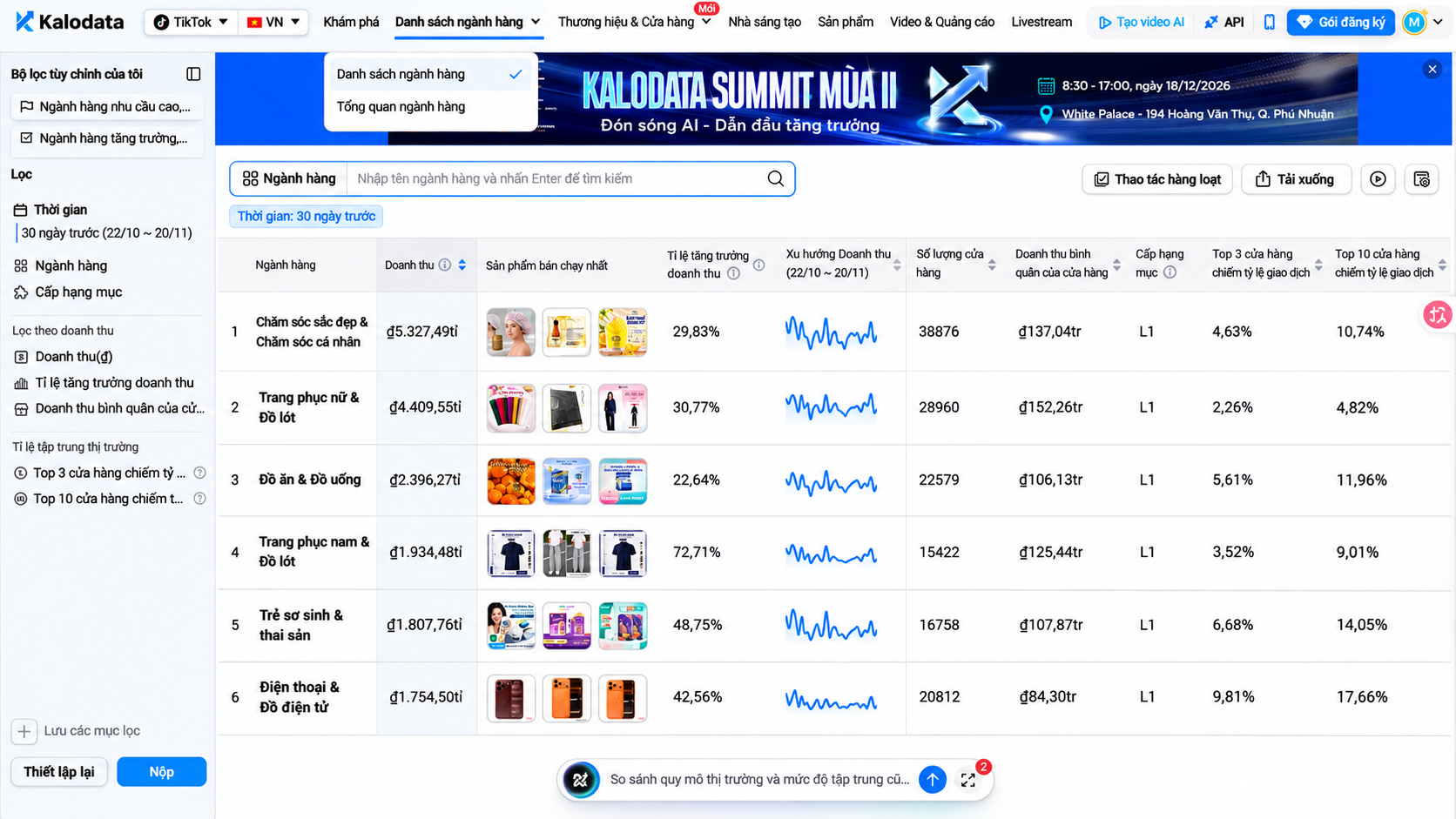
Step 1. Narrow down by market and product category
Choose the Vietnamese market and a product category where you have an advantage: an existing supplier, an understanding of customers, or strong content creation skills. Do not start with platform-wide rankings; the leaders there are usually major brands with budgets you cannot match.
In the product rankings, set the filters:
Time period: 7 days and 30 days, to compare two timeframes.
Price range: the range in which you can sell profitably.
Sort by revenue growth rate, not by total revenue.
Record 15–20 fast-growing products.
Step 2. Check the quality of growth
Open each product's details page and check the chart.
Steady growth over several weeks is a good sign.
A sharp spike followed by a drop is usually caused by a viral video or a promotion. Entering later means arriving just as the wave ends.
Seasonal growth: compare with the same period if your plan includes enough historical data.
Next, look at the seller landscape:
How many shops are selling this product or similar products?
Is revenue concentrated in one shop or spread across several?
How many creators have generated sales?
The ideal market for beginners: demand is growing, multiple small sellers are making sales, and no one dominates yet. Narrow the list down to 6–8 products.
Step 3. See which content is generating sales
Products on TikTok sell through videos and livestreams. For each remaining product, open the list of related videos and livestreams:
Does revenue come from short videos or livestreams? If almost all sales come from livestreams by a few well-known people, you will struggle to replicate that success.
What do the best-selling videos have in common? The first three seconds, the presentation, the call to action.
Can small accounts make sales? If videos from accounts with a few thousand followers still generate orders, the product sells through content, not fame.
Can you create similar content, with your current resources?
Keep 3–4 products.
Step 4. Calculate profit margins and score the products
For each product, calculate the economics of a single order:
Profit = selling price − purchase cost − platform fees − creator commissions − shipping and packaging costs − allocated advertising costs − allowance for returns
Get platform fee and commission rates from TikTok Shop's current policy page, as they vary by category and over time. If a product is only profitable without paying commissions or running ads, rule it out.
Then score the products:
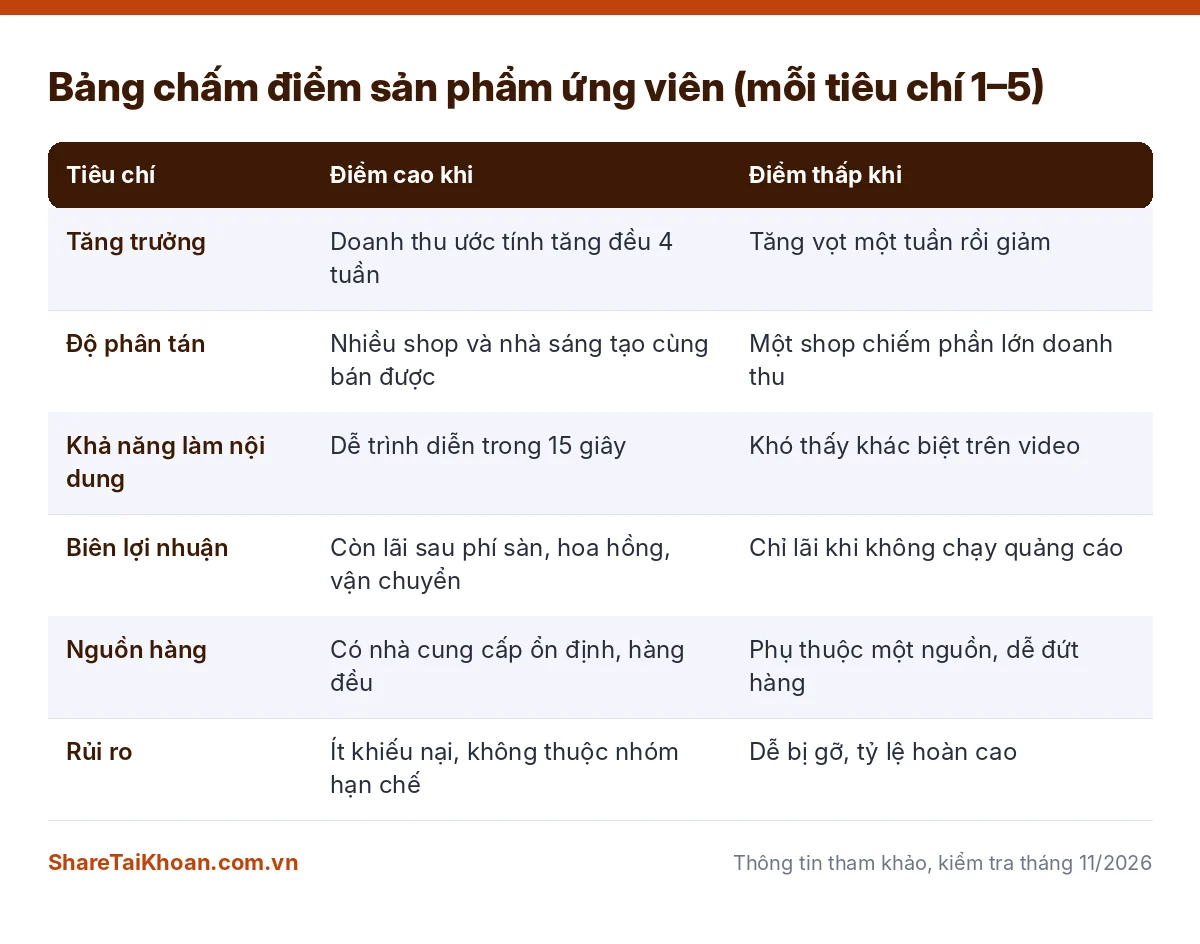
Choose up to three of the highest-scoring products to test.
Test small before ordering in bulk
Order small batches or sell without holding inventory if your supplier allows it.
Create 5–10 videos based on the formats you found effective in step 3.
Set a review point after 14 days: order count, conversion rate, return rate.
Only scale up products that meet the threshold.
Four data pitfalls
Relying on total revenue. The big numbers belong to those who got there first.
Ignoring the actual selling price. High revenue achieved by selling at a loss to boost rankings is not a model to follow.
Confusing views with purchases. A video with a million views does not necessarily generate orders; look at the estimated revenue associated with the video.
Overlooking policy risks. Some product categories require licences or are subject to advertising restrictions.
Frequently asked questions
How accurate is Kalodata's data?
These are estimates based on public signals. They are reliable enough for comparisons and identifying trends, but not enough to treat as a shop's actual revenue.
Which plan is enough for beginners?
Beginners usually only need the lowest-tier plan, provided its daily search limit is enough for the workflow above. See the options at Kalodata product page.

Once you have found a product, what comes next?
Find sellers to help you. Read the article find suitable KOLs/KOCs with Kalodata.
References
ShareTaiKhoan is an independent service, not Kalodata or a representative of Kalodata. Prices, limits and terms are set by the provider and may change; the information in this article was checked in November 2026.
(2 ratings - 5/5)
Buy affordable accounts at ShareTaiKhoan

Related products



Other articles
- Canva Pro or Photoshop? A Comparison for Marketing in 2026
- Runway Act-Two: Animate AI Characters Using Your Video
- Systematic Literature Reviews with Elicit: A 6-Step Process
- Semrush One and AI Visibility: Measuring Brand Presence in ChatGPT
- Create Natural Vietnamese AI Voiceovers with Vbee: 7 Techniques
- Adding Voiceovers to Videos and Lectures with Vbee: A 6-Step Process
- Using Perplexity for Keyword Research and SEO Competitor Analysis
Comments (0)
Sign in or register to comment.
No comments yet.